GEO vs SEO: Key Differences and AI Search Strategy
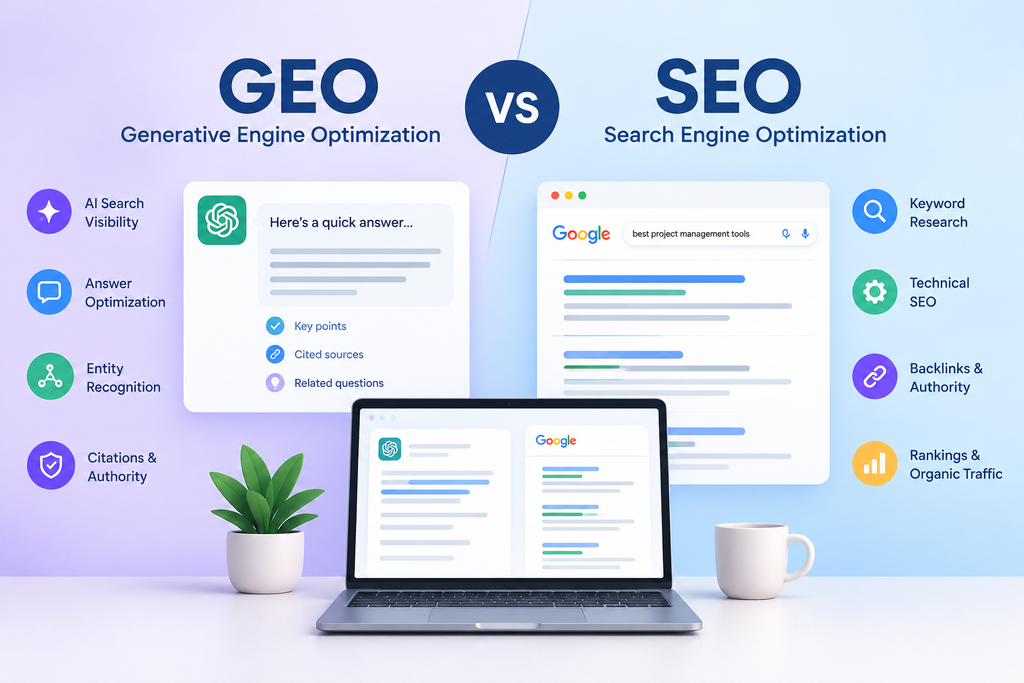
Search is changing. People are no longer relying only on traditional SEO vs GEO search engines and lists of blue links to find information. AI-powered search experiences can now interpret detailed questions, summarize information, compare sources, and provide answers with links to supporting websites.
This shift has created a new area of digital marketing called Generative Engine Optimization (GEO).
But how is GEO different from traditional Search Engine Optimization (SEO)? Is GEO replacing SEO, or should businesses use both?
The short answer is that GEO and SEO address related but different discovery environments. SEO focuses primarily on improving visibility in traditional search results, while GEO focuses on making information easier for generative AI systems to discover, understand, retrieve, cite, or mention.
Google says its AI Mode has surpassed one billion monthly users globally and that AI Mode queries have more than doubled each quarter since launch. This makes AI search visibility an increasingly relevant consideration for content teams.
What Is SEO?
Search Engine Optimization (SEO) is the process of improving a website and its content so that search engines can understand, index, and potentially rank it for relevant queries.
Traditional SEO can involve:
- Keyword research
- Search intent analysis
- Helpful and comprehensive content
- Technical SEO
- Internal linking
- Backlinks and authority
- Page experience
- Structured data
- Website accessibility
- Content freshness
The primary goal is to make a website more discoverable when someone searches through a conventional search engine.
For example, a business selling accounting software might create an article targeting the query “best accounting software for small businesses.” The company could optimize the page around that search intent and build relevant authority around the topic.
SEO remains important because search engines continue to connect users with websites, products, businesses, and original information.
What Is GEO?
Generative Engine Optimization (GEO) refers to optimizing content and digital information so that generative AI systems can more easily discover, understand, retrieve, cite, or represent that information in AI-generated answers.
GEO is relevant to systems and experiences such as:
- AI search
- Google AI Overviews
- Google AI Mode
- ChatGPT
- Perplexity
- Gemini
- Other generative search and answer systems
The concept is broader than simply “ranking in ChatGPT.” Research published in 2026 describes GEO as a multi-stage process involving discovery, retrieval, citation, representation, and other factors. The research also notes that evidence for stable, cross-platform GEO effects remains limited.
That distinction is important.
A company can have strong traditional search visibility while still having limited visibility in AI-generated answers. Likewise, appearing in an AI answer does not necessarily mean a website ranks highly for every related Google search.
GEO vs SEO: What Is the Difference?
The biggest difference between GEO vs SEO is the environment in which information is discovered and presented.
| SEO | GEO |
|---|---|
| Focuses on search engine visibility | Focuses on visibility in generative AI experiences |
| Often targets search result rankings | Often targets inclusion, citation, or representation in AI answers |
| Uses keywords and search intent | Uses questions, entities, context, and answer clarity |
| Optimizes pages for search engines and users | Optimizes information for retrieval and interpretation by AI systems |
| SERPs are a major measurement environment | AI answers and citations are important measurement environments |
| Rankings are a familiar SEO metric | AI visibility requires broader measurement |
These approaches overlap significantly. High-quality content, clear structure, authoritative sources, crawlability, and strong topical relevance can matter to both.
The difference is primarily in how information is retrieved and presented to the user.
Why Is GEO Becoming Important?
AI is changing how people formulate and explore searches.
Google reports that people using AI Mode are asking longer and more complex questions, rather than relying only on short traditional queries.
For content marketers, this creates a new discovery environment.
A user might traditionally search:
“CRM software for startups”
With an AI search system, the same person might ask:
“What CRM should a five-person startup use if it needs simple sales tracking, email integration, and affordable pricing?”
The second query contains more context, constraints, and intent.
This means businesses need content that does more than repeat keywords. It should explain concepts clearly, address related questions, establish entities, provide useful evidence, and make important information easy to interpret.
AI Search Is Becoming More Conversational
Google has continued expanding conversational AI features in Search, including AI Mode and AI Overviews. Its 2026 updates describe an increasingly integrated experience in which users can move from questions to AI-generated responses and then explore supporting web pages.
For publishers, this means the relationship between SEO and AI search optimization is becoming increasingly connected.
Is GEO Replacing SEO?
No, GEO Should Not Be Treated as a Replacement for SEO
GEO and SEO should generally be viewed as complementary disciplines.
Traditional SEO still helps search engines discover and understand web content. GEO adds another consideration: whether the information is clear, credible, structured, and useful enough to be retrieved and represented within generative answers.
A useful content strategy therefore looks at both:
SEO → Can people find this content through traditional search?
GEO → Can AI systems understand, retrieve, cite, or accurately represent this information when answering relevant questions?
Neither question guarantees a particular result.
AI-generated visibility depends on factors such as crawling, indexing, retrieval systems, source authority, query context, system design, and changing platform behavior.
How to Optimize Content for GEO and SEO
1. Start With Search Intent
Before creating content, identify what the reader actually wants to accomplish.
A keyword such as “GEO vs SEO” indicates a comparison-oriented information need. The reader may want to understand:
- What GEO means
- What SEO means
- How they differ
- Whether GEO replaces SEO
- How to optimize content for AI search
- How AI visibility can be measured
Answering these questions naturally creates stronger topical coverage than repeatedly inserting the same keyword.
2. Give Direct Answers
AI-friendly content should make important answers easy to identify.
Start major sections with a concise answer, then provide context, explanation, evidence, examples, and limitations.
For example:
GEO is an approach to improving how content can be discovered, understood, retrieved, and represented by generative AI systems. It complements rather than automatically replaces traditional SEO.
This structure is useful for people as well as search and AI systems.
3. Build Clear Topic and Entity Relationships
AI systems need context.
Instead of repeatedly using a keyword, explain the relationship between concepts.
For example:
- SEO → traditional search visibility
- GEO → generative AI visibility
- AEO → answer-focused optimization
- AI Search → AI-powered discovery
- AI Overviews → AI-generated search summaries
- Generative engines → systems that synthesize information into responses
Clear entity relationships make an article easier to understand and reduce ambiguity.
4. Use Credible Sources
GEO should not mean adding statistics or claims simply because they might look attractive in an AI answer.
Use authoritative sources where possible, particularly for changing platform features, technical guidance, research findings, and industry data.
Google itself publishes guidance and updates about its AI Search experiences, making its first-party documentation useful when discussing Google-specific functionality.
5. Add Original Value
Generic summaries are easy to reproduce.
A stronger GEO and SEO strategy adds something useful, such as:
- Original research
- First-hand data
- Practical examples
- A comparison framework
- Expert commentary
- A useful checklist
- Implementation guidance
- Clearly explained limitations
This aligns with an important editorial principle: search-led content should satisfy the reader’s task while adding meaningful information gain rather than simply copying existing results.
6. Make Content Easy to Navigate
Use descriptive headings, short paragraphs, tables, lists, definitions, and logical sections.
Do not create dozens of shallow FAQ sections simply to target more queries. Each section should serve a distinct purpose and contribute to the article’s overall answer.
GEO vs SEO: Which One Should Businesses Use?
Use SEO for Traditional Search Visibility
SEO remains relevant when your goal is to attract users through traditional search results.
Focus on:
- Search intent
- Technical accessibility
- Relevant content
- Internal linking
- Authority
- Useful page structure
- Topic coverage
Use GEO to Prepare for AI Search
GEO becomes relevant when your audience increasingly uses AI-generated answers to research topics, compare options, or discover brands.
Focus on:
- Clear answers
- Strong source attribution
- Consistent brand information
- Entity clarity
- Original evidence
- Structured content
- Credible references
- Accessible web pages
Use Both for a Broader Search Strategy
For many organizations, the practical approach is not GEO vs SEO, but GEO plus SEO.
A well-optimized article can target traditional search intent while also presenting information in a format that is easy for AI systems and human readers to understand.
Common GEO and SEO Mistakes
Mistake 1: Treating GEO as a Keyword Trick
GEO is not simply about inserting terms such as “ChatGPT,” “AI search,” or “generative engine optimization” into every paragraph.
Keyword stuffing can reduce readability without creating meaningful value.
Mistake 2: Assuming AI Visibility Is Guaranteed
No content strategy can guarantee that an AI platform will cite or recommend a particular page.
AI visibility depends on systems and variables outside a publisher’s complete control.
Mistake 3: Publishing Thin AI-Generated Content
Creating large quantities of shallow pages does not automatically create authority.
Useful content should answer a real reader question and provide accurate, distinctive information.
Mistake 4: Ignoring Traditional SEO
Focusing exclusively on GEO while neglecting technical SEO, crawlability, content quality, or website structure can create unnecessary gaps.
How to Measure AI Search Visibility
Track More Than Rankings
Traditional SEO can be measured using metrics such as:
- Organic impressions
- Organic clicks
- Search rankings
- Organic sessions
- Conversions
AI search requires additional measurements.
Depending on the platform and available tools, teams may monitor:
- Brand mentions in AI answers
- Citation frequency
- Cited URLs
- Competitor mentions
- AI referral traffic
- Query-level visibility
- Accuracy of brand descriptions
However, these measurements should be treated carefully. AI answers can vary between queries, sessions, platforms, and time periods.
A 2026 research survey of GEO studies found substantial variability in AI visibility and concluded that stable cross-platform effects have not yet been firmly established.
Build a Repeatable Measurement Process
A useful process is to create a set of relevant customer questions and periodically test how different AI search systems respond.
Record:
- The exact question
- The AI platform
- Whether the brand appears
- Whether the website is cited
- Which competitors appear
- Which sources are referenced
- Whether the information is accurate
- Changes over time
This produces a more meaningful picture than relying on a single AI response.
What Does the Future of SEO and GEO Look Like?
The distinction between traditional search and AI search is likely to become less rigid as search platforms continue integrating generative AI.
Google’s current Search developments already combine conventional search infrastructure with AI-generated answers, follow-up questions, links, and AI-powered exploration.
That means marketers should not abandon SEO in favor of GEO.
Instead, the stronger long-term approach is to create useful, authoritative, accessible, well-structured content that works across discovery environments.
The Future Is Search Visibility Across Multiple Interfaces
People may discover the same business through:
- Traditional search results
- AI Overviews
- AI Mode
- Chat-based AI tools
- Recommendation systems
- Social platforms
- Direct website searches
The underlying editorial requirement remains similar: provide information that is accurate, useful, understandable, and supported by credible evidence.
Final Thoughts: GEO vs SEO
The GEO vs SEO debate is less about choosing one optimization method and more about understanding how search behavior is evolving.
SEO remains focused on helping websites become discoverable and useful within traditional search ecosystems. GEO addresses a newer challenge: making information easier for generative AI systems to discover, understand, retrieve, cite, and represent accurately.
The best starting point is not trying to “hack” an AI system. It is building content that deserves to be found.
Create clear answers. Use credible sources. Explain concepts precisely. Build strong topic and entity relationships. Add original value. Keep your website accessible and technically sound. Then measure how your content performs across the discovery environments that matter to your audience.
GEO may change as AI platforms evolve, but the underlying principle is durable: make your information genuinely useful, trustworthy, and easy to understand.
A Practical GEO and SEO Checklist
Before publishing an AI-search-focused article, ask:
- Does the article satisfy one clear reader intent?
- Is the primary question answered directly?
- Are the primary and secondary keywords used naturally?
- Are important entities clearly defined?
- Are material claims supported by credible sources?
- Does the article include original value?
- Are headings descriptive and logically structured?
- Can important answers stand alone when extracted from the page?
- Is the website technically accessible to search systems?
- Are limitations and uncertainties clearly stated?
- Are AI visibility claims presented without guarantees?
- Has the content been reviewed for accuracy and originality?
A strong GEO and SEO strategy starts with the reader—not the algorithm.