AI Agents in 2026: How Autonomous AI Is Changing Work
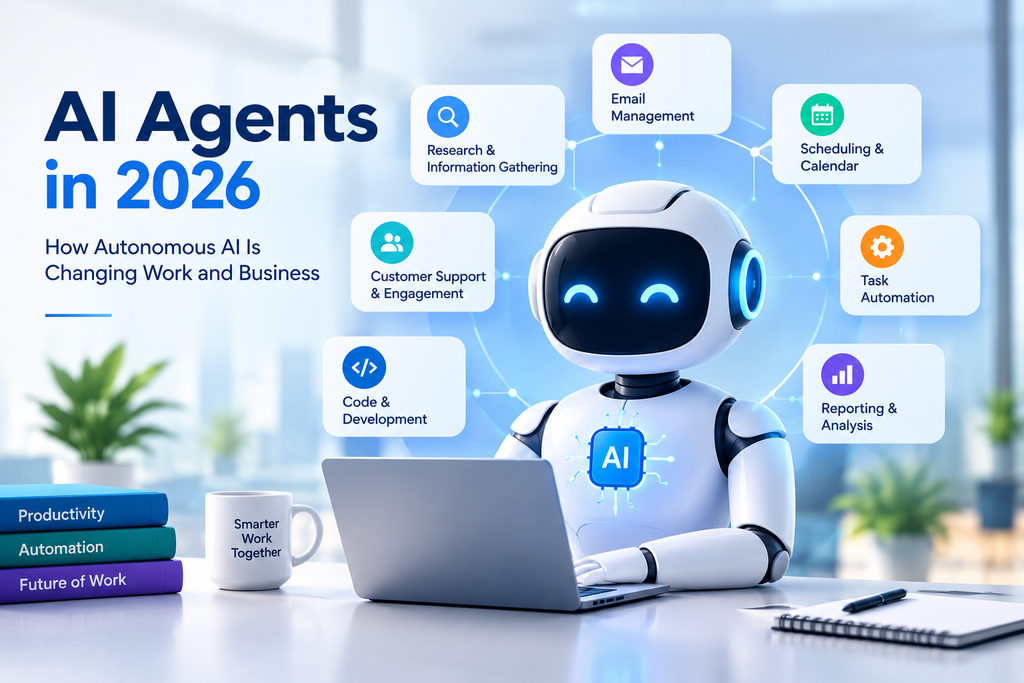
Artificial intelligence is moving beyond simple chatbots and question-answering tools. In 2026, one of the biggest developments in AI is the rise of AI agents—systems designed to plan tasks, use tools, work across applications, and complete multi-step workflows with varying levels of human supervision.
Instead of simply responding to a prompt, an AI agent can be given a goal and then determine the steps needed to accomplish it.
For businesses, this could mean an AI agent researching leads, summarizing customer requests, updating records, preparing reports, or coordinating information across different software tools.
Google Cloud describes this shift as a move from individual prompts toward AI agents that can orchestrate complex, end-to-end workflows. Gartner’s 2026 research similarly shows strong interest in agentic AI, while warning that enterprise readiness and reliability vary significantly by use case.
So, what exactly are AI agents, how do they work, and what can businesses realistically do with them in 2026?
What Are AI Agents?
AI agents are AI-powered systems that can pursue a defined goal by reasoning through tasks, using available tools or data, and taking actions with some degree of autonomy.
A traditional chatbot generally waits for a user to ask a question and then generates a response.
An AI agent can go further.
For example, instead of asking an AI assistant:
“Summarize these five customer emails.”
A business could use an AI agent with an instruction such as:
“Review new customer support requests, identify urgent issues, summarize them, update the appropriate ticket, and flag anything requiring human attention.”
The difference is the workflow.
AI agents can combine reasoning, information retrieval, tool use, memory or context, and actions to complete a broader objective.
AI Agents vs AI Assistants
AI assistants and AI agents are related, but the terms are not always interchangeable.
An AI assistant commonly helps a person perform a task by generating information, suggestions, or content.
An AI agent is generally designed to perform a sequence of tasks toward a goal and may interact with external tools or systems.
This distinction is not absolute because vendors use the terminology differently. Gartner itself notes that terms such as “AI agents” and “agentic AI” are increasingly overused and that different technologies have different levels of maturity.
How Do AI Agents Work?
An AI agent typically combines several capabilities.
1. Goal Understanding
The agent first interprets what it is being asked to accomplish.
For example:
Goal: Prepare a weekly sales report.
The agent may determine that it needs sales data, customer information, recent activity, and a reporting format.
2. Planning and Reasoning
The agent breaks the objective into smaller steps.
A sales reporting agent might:
- Retrieve the latest sales data.
- Compare it with the previous period.
- Identify significant changes.
- Summarize the findings.
- Create a report.
- Send it for approval.
The exact process depends on how the agent has been designed and what tools it can access.
3. Tool Use
An AI agent becomes more useful when it can interact with external tools.
These tools might include:
- Databases
- CRM platforms
- Email systems
- Spreadsheets
- Project management software
- Customer support systems
- Internal knowledge bases
- APIs
- Web search tools
OpenAI’s current workspace-agent offering, for example, allows eligible business and enterprise users to create agents for repeatable workflows, connect tools, schedule tasks, and apply permissions and approval controls.
4. Taking Action
The final step is action.
Depending on the permissions provided, an agent might update a record, create a document, prepare a message, organize information, or initiate another workflow.
This is where AI automation becomes significantly more powerful than simple text generation.
Why Are AI Agents Trending in 2026?
The Shift From Chatbots to Agentic AI
The AI industry is increasingly moving from systems that simply respond to users toward systems that can participate in workflows.
Google Cloud says organizations are moving beyond basic AI assistants toward proactive AI agents that can anticipate goals, reason through complexity, and orchestrate business processes.
Gartner’s 2026 Hype Cycle for Agentic AI also highlights the rapid growth of interest in this technology. According to Gartner, 17% of organizations had deployed AI agents at the time of its survey, while more than 60% expected to do so within the following two years. Gartner also cautions that most current deployments remain narrowly scoped and that fully autonomous agents are not ready for the majority of enterprise use cases.
That combination—rapid interest but uneven readiness—is one of the most important things businesses should understand about AI agents in 2026.
AI Agent Use Cases for Businesses
AI agents can potentially support many business functions, but the strongest use cases are usually specific workflows rather than vague attempts to automate an entire department.
Customer Service AI Agents
Customer service is one of the most obvious applications.
An AI agent can help:
- Categorize incoming support requests
- Retrieve relevant customer information
- Summarize conversations
- Draft responses
- Identify urgent cases
- Route tickets
- Update support records
A human employee can then review cases that require judgment or escalation.
Why This Matters
The goal should not simply be to replace customer service employees.
A better approach is to allow AI agents to handle repetitive workflow steps while employees focus on complex problems, sensitive interactions, and decisions requiring human judgment.
Sales and Lead Management
AI agents can also assist sales teams.
A sales agent could potentially:
- Research prospects
- Organize lead information
- Identify missing data
- Summarize previous interactions
- Prepare follow-up drafts
- Update CRM records
- Generate sales reports
This can reduce administrative work and give sales representatives more time for conversations and relationship-building.
AI Agents for Research
Research is another strong use case.
An AI research agent can be designed to gather information from approved sources, organize findings, compare information, and prepare a structured research brief.
However, human review remains important.
AI systems can make factual errors, misinterpret sources, or present uncertain information too confidently. Research workflows should therefore include source verification and review rather than treating agent-generated output as automatically correct.
Software Development
AI agents are also being used in software development workflows.
Depending on the tools and permissions available, coding agents can help with tasks such as:
- Understanding an existing codebase
- Writing code
- Creating tests
- Debugging
- Reviewing changes
- Preparing documentation
- Running development tools
This represents a shift from AI that merely suggests code toward AI systems that can participate in broader software-engineering workflows.
Finance and Operations
Business operations can also benefit from workflow-based AI automation.
Potential examples include:
- Preparing financial summaries
- Reconciling information
- Monitoring operational metrics
- Generating recurring reports
- Processing internal requests
- Identifying anomalies for review
For financial workflows, however, organizations should apply stricter controls because incorrect actions can have significant consequences.
AI Agents vs Traditional Automation
What Is the Difference?
Traditional automation generally follows predefined rules.
For example:
If a customer submits Form A → send Email B.
An AI agent can work with more flexible instructions.
For example:
Review this customer request, determine what information is needed, find the relevant account details, prepare the appropriate response, and escalate unusual cases.
The distinction is that agentic systems can potentially interpret less-structured information and determine intermediate steps.
But flexibility comes with risk.
Traditional automation is often easier to predict and test. AI agents can introduce uncertainty because their outputs and decisions may vary.
When Should Businesses Use AI Agents?
A good candidate workflow usually has:
- A clearly defined goal
- Repeatable steps
- Accessible data
- Well-defined permissions
- Measurable outcomes
- Manageable risks
- A clear escalation process
If a workflow has no clear objective or requires constant subjective judgment, an AI agent may not be the right starting point.
Benefits of AI Agents in 2026
Increased Productivity
AI agents can take on repetitive administrative work and allow employees to focus on higher-value activities.
The productivity benefit depends heavily on workflow design, integration quality, and the level of human oversight.
Faster Workflow Execution
An agent that can retrieve information and perform multiple steps without waiting for a person at every stage can reduce workflow delays.
Better Scalability
Once a workflow is properly designed, organizations may be able to run it repeatedly without increasing manual effort at the same rate.
More Personalized Experiences
AI agents can potentially use customer or business context to provide more tailored interactions.
This could affect customer service, sales, marketing, and internal employee support.
The Risks of AI Agents
The promise of autonomous AI should not distract from its risks.
Incorrect Decisions
An agent can misunderstand an instruction, use incorrect information, or make an inappropriate decision.
Security and Privacy
AI agents may have access to sensitive business systems and data.
The more permissions an agent has, the greater the potential impact if something goes wrong.
Excessive Autonomy
Giving an AI agent permission to make irreversible decisions without human approval can create unnecessary risk.
Recent reporting has highlighted concerns about autonomous agents, including questions around control, safety, and accountability.
Hidden or “Shadow” AI Agents
Another emerging issue is employees creating or using AI agents outside formal organizational oversight.
Gartner warned in September 2026 about “shadow AI” agents that may be embedded in software, accessed from the internet, or created by employees without adequate organizational governance.
This makes AI governance increasingly important.
How Businesses Can Start Using AI Agents
Start With One Workflow
Do not begin by trying to create an AI agent for everything.
Choose one specific workflow where the potential value is easy to measure.
For example:
Customer support ticket → classify → summarize → retrieve relevant information → draft response → human approval.
This is easier to test than an unrestricted “customer service agent.”
Define Human Approval Points
Businesses should determine which actions an agent can perform independently and which actions require approval.
For example:
| Agent action | Suggested control |
|---|---|
| Summarize information | Automated |
| Classify a request | Automated with monitoring |
| Draft an email | Human review |
| Update internal data | Permission-based |
| Send sensitive communication | Human approval |
| Make financial transaction | Strong approval controls |
The appropriate controls will vary by industry and risk level.
Measure Business Outcomes
Do not measure an AI agent simply by how impressive its responses appear.
Track outcomes such as:
- Time saved
- Cost per workflow
- Error rate
- Resolution time
- Customer satisfaction
- Employee productivity
- Escalation rate
- Accuracy
- Compliance incidents
Gartner’s recent analysis emphasizes that the strongest value is likely to come from specialized, domain-specific agents rather than overly broad systems.
The Future of AI Agents
From Individual Agents to Agentic Workflows
The next stage of AI automation is unlikely to involve only one agent working alone.
Organizations are increasingly exploring systems where multiple AI agents, software tools, and human employees work together.
For example:
Research agent → analysis agent → reporting agent → human reviewer
This could create more sophisticated workflows, but it also introduces additional coordination and governance challenges.
AI Agents Will Need Better Governance
As AI agents gain access to more systems, businesses will need to answer important questions:
- Who owns the agent?
- What data can it access?
- What actions can it take?
- Who approves high-risk actions?
- How are actions logged?
- How can an agent be stopped?
- How are errors investigated?
Google Cloud’s 2026 agentic-enterprise guidance similarly emphasizes the need for collaboration between AI agents and human experts rather than treating autonomy as the only goal.
Reliability May Matter More Than Maximum Autonomy
The future of AI agents is not necessarily about giving AI unlimited independence.
For many businesses, the more valuable goal may be controlled autonomy.
An agent that reliably completes 90% of a well-defined workflow and escalates the remaining 10% may be more useful than an agent that attempts to do everything independently but produces unpredictable results.
A Practical AI Agent Adoption Framework
Businesses can use a simple five-step process:
Step 1 — Identify the Workflow
Choose a repetitive process with a measurable outcome.
Step 2 — Define the Agent’s Role
Specify exactly what the AI agent can and cannot do.
Step 3 — Connect Approved Tools
Give the agent access only to the data and applications required for the workflow.
Step 4 — Add Human Oversight
Create approval checkpoints for sensitive or irreversible actions.
Step 5 — Measure and Improve
Track accuracy, cost, speed, errors, and business outcomes before expanding the agent’s responsibilities.
Conclusion: Are AI Agents the Future of Work?
AI agents are becoming an important part of the next phase of business automation.
Unlike traditional chatbots, AI agents can be designed to work toward goals, use tools, coordinate multiple steps, and complete portions of business workflows.
In 2026, the opportunity is real, but so are the limitations.
Organizations should not adopt AI agents simply because they are trending. They should identify specific workflows where AI can create measurable value while maintaining appropriate human oversight, security, and governance.
The most effective strategy is likely to be focused rather than unlimited autonomy.
Start with a well-defined process. Give the agent appropriate tools. Set clear permissions. Measure the results. Then expand only when the system proves reliable.
The future of work may not be humans versus AI agents. It may be humans and AI agents working together, with people providing judgment, accountability, creativity, and oversight while AI handles increasingly complex digital workflows.
Pingback: GEO vs SEO: Key Differences and AI Search Strategy